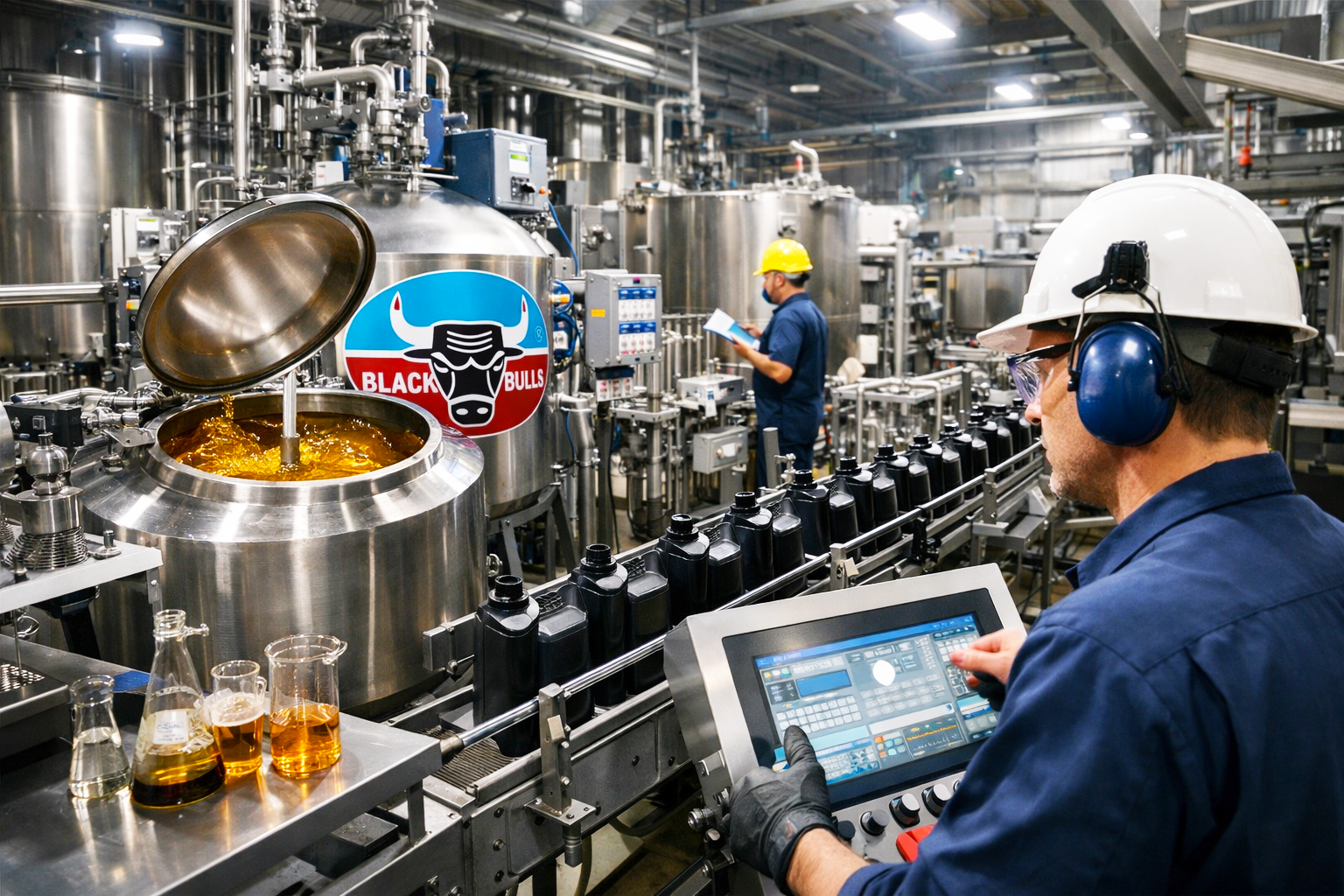
Performance in lubricants does not start with branding. It starts on the factory floor. The way raw materials are handled, the way blending is controlled, and the way consistency is protected over time all shape how a lubricant behaves in real machines.
Many buyers only see the finished product. What they do not see is the process behind it. That process is what separates average lubricants from those built for long-term industrial use.
Inside a performance-driven operation, every step exists for one reason. To protect lubrication quality and ensure predictable performance under load.
Performance Begins Before Blending
A lubricant’s performance is largely decided before blending even starts.
Base oils and additives are not interchangeable parts. Different sources behave differently under heat, pressure, and long operating hours. If input quality varies, output performance will vary as well.
That is the reason why performance-driven manufacturing starts with tight control over raw materials. Selection is based on quality and stability, not just availability. The materials that degrade quickly under stress are avoided, even if they meet minimum specifications.
This approach helps protect long-term lubrication quality and reduces the risk of early performance drop-off.
Blending Is Where Discipline Matters Most
Blending is the stage where most quality problems are created or prevented.
Ratios must be exact. Temperatures must be controlled. Mixing time matters. Small deviations may not show immediately, but they appear later in the field.
In a performance-driven lubricant manufacturing process, blending follows fixed procedures. Adjustments are not made casually. Operators follow defined parameters every time.
Such discipline ensures one batch behaves the same as the next. For industrial buyers, this repeatability matters more than any claim on a label.
Consistency Is the Real Performance Metric
Performance is often measured in tests. Buyers measure it in outcomes.
If lubrication behavior changes between shipments, machines respond differently. Wear patterns change. Maintenance schedules are not easy to predict. Over time, energy consumption may rise as friction increases inside the system.
For a performance-driven process, consistency is a core objective. The goal is not to produce a strong batch once, but to produce the same result again and again.
This consistency supports predictable equipment behaviour and stable operating costs.
Designing for Stress, Not Ideal Conditions
Many lubricants are developed under controlled conditions. Real operations are rarely controlled.
Heat, dust, heavy loads, and long operating hours expose weaknesses quickly. Lubricants that perform well in easy and mild conditions may struggle when the stress becomes constant.
A performance-driven manufacturing process assumes stress from the start. Formulations are designed to resist oxidation, maintain viscosity, and protect surfaces under pressure.
This approach supports better machinery efficiency and reduces the risk of unexpected wear.
Lubrication Quality and Energy Behaviour
The direct relationship between lubrication quality and energy consumption is mechanical.
When lubrication films weaken, friction increases and the increased friction generates heat. Heat forces machines to work harder. This extra effort shows up as higher fuel or power use.
High-quality lubricants reduce internal resistance and over time, this supports smoother operation and better energy efficiency. These improvements are gradual, but they are measurable in continuous operations.
Performance-driven manufacturing takes this relationship seriously, because buyers feel the cost impact over time.
Testing Is Used as Control, Not Marketing
Testing is often discussed as a selling point. In reality, it is a control mechanism.
Viscosity, stability, and contamination are monitored to ensure products stay within defined performance limits. Testing helps detect variation before products reach the field.
In a performance-driven process, testing is routine. It exists to protect lubrication quality, not to generate brochures.
For B2B buyers, this testing discipline reduces surprises and builds confidence in supply.
Why Long-Term Performance Matters More Than Initial Results
Many lubricants perform well at the start of their service life. The real difference appears later.
As operating hours increase, weaker formulations begin to degrade. Friction rises. Heat builds faster. Energy consumption increases without knowing a failure point.
A performance-driven manufacturing process focuses on durability. Products are designed to maintain the protective properties over extended service intervals.
This long-term view aligns better in business if we consider the industrial realities, where downtime and inefficiency carry real cost.
Bulk and Industrial Use Change the Equation
Bulk and industrial applications place different demands on lubricants.
Large volumes, continuous operation and limited downtime, in these environments, variation becomes expensive quickly.
A performance-driven process accounts for this by prioritizing stability and repeatability. Consistent lubrication quality helps to maintain machinery efficiency and reduces the risk of unplanned maintenance.
This is why bulk buyers often value manufacturing discipline more than short-term pricing.
Process Over Promotion
Many lubricant brands invest heavily in promotion. Fewer invest deeply in the process.
A performance-driven approach places process first. The logic is simple. If the manufacturing process is controlled, performance follows naturally.
For buyers, this means fewer investigations, fewer adjustments, and more predictable outcomes across time.
Why Manufacturing Method Is a USP
The manufacturing method is often invisible, but it has a real impact.
It determines how consistently products perform. It influences how systems behave under load. It affects how energy consumption trends over time.
A performance-driven lubricant manufacturing process turns manufacturing discipline into a functional USP. Buyers may not see it directly, but they experience the results.
Performance Is Built, Not Claimed
Performance does not come from a single ingredient or test. It comes from how the entire process works together.
Raw material control, blending discipline, routine testing, and long-term performance evaluation. Each step supports the next.
This integrated approach protects lubrication quality, supports energy efficiency, and helps industrial buyers manage operational risk.
Inside a performance-driven lubricant manufacturing process, nothing is accidental.
Every step exists to protect consistency and long-term performance. This focus supports stable lubrication quality, controlled energy consumption, and reliable machinery efficiency in real operating conditions.
For B2B buyers, distributors, and industrial operators, understanding the manufacturing process matters as much as understanding the product.
Because in lubrication, performance is not promised. It is built.