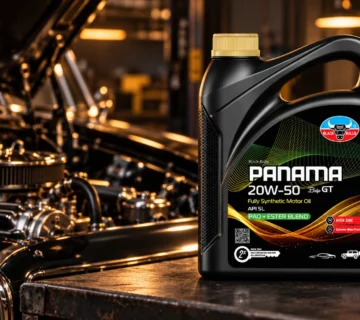

Your car needs the engine oil viscosity recommended by its manufacturer, usually listed in the owner’s manual or service information. Grades such as 5W-30, 5W-40, and 5W-50 are not simply different levels of “thickness” or quality. Each behaves differently when the engine is cold and once it reaches operating temperature. In the UAE, high ambient temperatures matter, but that does not automatically mean every car should use thicker oil. Start with the manufacturer-approved viscosity and specification, then consider your vehicle, mileage, and driving conditions.
Choosing engine oil often gets more complicated than it needs to be, especially when different garages, mechanics and lubricant suppliers in Dubai seem to offer different recommendations.
You arrive for a service and hear, “Do you want 5W-30 or 5W-40?” Maybe someone recommends 5W-50 because Dubai is hot. Another person says thinner oil will improve fuel economy. Then there is synthetic, semi-synthetic, API specifications, manufacturer approvals, and several bottles that all claim to protect your engine.
The numbers actually make sense once you know what they are telling you.
And understanding them is worthwhile. The right viscosity helps oil circulate properly, maintain an effective lubricating film,m and protect moving components across the engine’s operating range.
What do 5W-30, 5W-40 and 5W-50 actually mean?
Take 5W-30 as an example.
The 5W describes the oil’s low-temperature viscosity characteristics. The “W” refers to winter. A lower number before the W generally indicates better flow characteristics at lower temperatures.
The 30 describes the oil’s viscosity classification at high operating temperatures.
So when comparing 5W-30 and 5W-40, both have the same SAE winter grade, but the 5W-40 falls into a higher viscosity grade at operating temperature.
That does not mean 5W-40 is automatically better because it is thicker. Engine oil needs to match the clearances, oil pump, lubrication system, em and operating requirements the engine was designed around.
Think of viscosity as a specification to match, rather than a quality score.
5W-30 vs 5W-40: which one should you choose?
This is probably one of the most common comparisons UAE drivers encounter.
5W-30 is widely specified for modern petrol and diesel engines. Depending on the engine design, it can support efficient oil circulation and may contribute to lower friction and fuel consumption.
5W-40 maintains a higher viscosity at operating temperature. It is commonly specified for certain European vehicles, turbocharged engines, and other applications where the manufacturer requires that viscosity range.
For a car owner, however, the important word is specified.
If your manufacturer approves both 5W-30 and 5W-40 for your particular engine and operating conditions, there may be room to choose between them. If the manual specifies only one grade, changing viscosity simply because the weather is hot is not a great servicing strategy.
Modern engines are engineered around very specific lubrication requirements.
Then where does 5W-50 fit in?
5W-50 covers a wider viscosity range and maintains a higher viscosity at operating temperature than 5W-30 or 5W-40.
You may see it specified or used in certain performance-oriented engines and applications involving demanding operating conditions. Some enthusiasts also consider higher-viscosity oils for vehicles exposed to sustained high loads or track use.
But again, 5W-50 should not be treated as a universal “high-performance upgrade.”
Putting 5W-50 into an engine designed specifically for a lower-viscosity oil can change oil flow and pumping characteristics. The fact that an oil sounds more performance-focused does not mean it is appropriate for every engine.
Performance starts with using the correct specification.
“But Dubai is extremely hot. Shouldn’t I use thicker oil?”
This is where a lot of oil advice goes wrong.
Yes, UAE driving can be demanding. Summer temperatures are severe, air-conditioning is almost constantly running, traffic can involve long periods of idling, and highway journeys may mean sustained engine operation in high ambient temperatures.
That makes oil quality, thermal stability,y and correct viscosity important.
It does not mean you should automatically move from 5W-30 to 5W-40 or 5W-50.
Your engine’s internal operating temperature is controlled by its cooling and lubrication systems, and vehicle manufacturers test engines for a range of climates and operating conditions. Many modern cars sold in the Gulf still specify relatively low-viscosity oils.
Check whether your manufacturer provides different viscosity recommendations for different ambient-temperature ranges. If it does, UAE conditions can influence the selection. If it does not, stay with the specified grade.
Your driving style matters too
Two identical cars can have very different lives.
One might travel 25 kilometres each morning on an open highway. Another spends most of its time crawling through stop-start traffic, making short journeys and idling outside buildings with the AC running.
Then there is the enthusiast who takes the same model on spirited weekend drives.
Those operating patterns affect the oil differently.
Frequent short trips, extended idling, heavy loads, and sustained high-temperature operation can make oil selection and service intervals more important. Fleet vehicles and commercial cars may accumulate mileage particularly quickly, so oil condition and maintenance scheduling deserve closer attention.
This is also why garages and fleet operators should look beyond price when comparing lubricant suppliers in Dubai. Consistent product quality, correct specifications, traceable supply, and availability of the required grades matter far more than saving a small amount on each oil change.
What about a high-mileage engine?
This deserves some caution.
Drivers sometimes notice increased oil consumption in an older vehicle and immediately switch to a thicker oil. Occasionally, a different manufacturer-approved viscosity may be appropriate, but thicker oil is not a repair for mechanical wear.
Higher oil consumption can have several causes, including leaks, worn seals, piston-ring wear,r or other engine issues.
If your vehicle has accumulated significant mileage, check the oil level regularly and pay attention to changes in consumption. If it suddenly starts using much more oil than before, investigate the cause instead of simply changing viscosity and hoping it disappears.
Viscosity is only half the label.
Finding the correct SAE grade is important, but don’t stop at “5W-30.”
Two 5W-30 oils can meet different performance specifications.
Look for the required API, ACEA, or vehicle-manufacturer approval/specification stated for your engine. Depending on the vehicle, the manufacturer may require a particular oil standard because of the engine design, emissions system, turbocharger, or service interval.
So the better question is not:
“Which 5W-30 should I buy?”
It is:
“Which 5W-30 meets the specification required by my engine?”
That small change in thinking can prevent a surprisingly common maintenance mistake.
A simple check before your next oil change
Before buying oil or approving your next service, check four things:
- Manufacturer-recommended SAE viscosity – for example, 0W-20, 5W-30, or 5W-40.
- Required performance specification or approval – check the owner’s manual or manufacturer service information.
- Your actual driving conditions – normal commuting, heavy traffic, towing, commercial use,se or performance driving.
- The oil itself – use genuine, properly sourced lubricant that meets the required specification.
For workshops and fleet buyers purchasing larger quantities, supplier reliability becomes part of that decision. Established lubricants suppliers in Dubai should be able to clearly identify the grades and specifications they supply rather than recommending one generic engine oil for every vehicle.
So, which oil does your car actually need?
Probably not the thickest one on the shelf. And not necessarily the oil your friend uses in a completely different engine.
Your car needs an oil whose viscosity and performance specification match the requirements of its engine.
For some vehicles, that will be 5W-30. Others are designed for 5W-40, 0W-20, 0W-30, or another grade entirely. Certain performance applications may call for 5W-50. UAE heat and driving conditions certainly deserve consideration, but they should be considered within the manufacturer’s recommendations, not used as a reason to ignore them.
A good engine oil does a difficult job quietly. You rarely notice it when everything is working properly. And that’s exactly the point.
The right oil choice isn’t about finding the biggest number on the bottle. It’s about giving the engine what it was designed to run on.
Looking for the right engine oil for your vehicle or business? Explore the range from Black Bulls Grease & Lubricants and choose a lubricant that matches your vehicle’s required viscosity and performance specifications.