
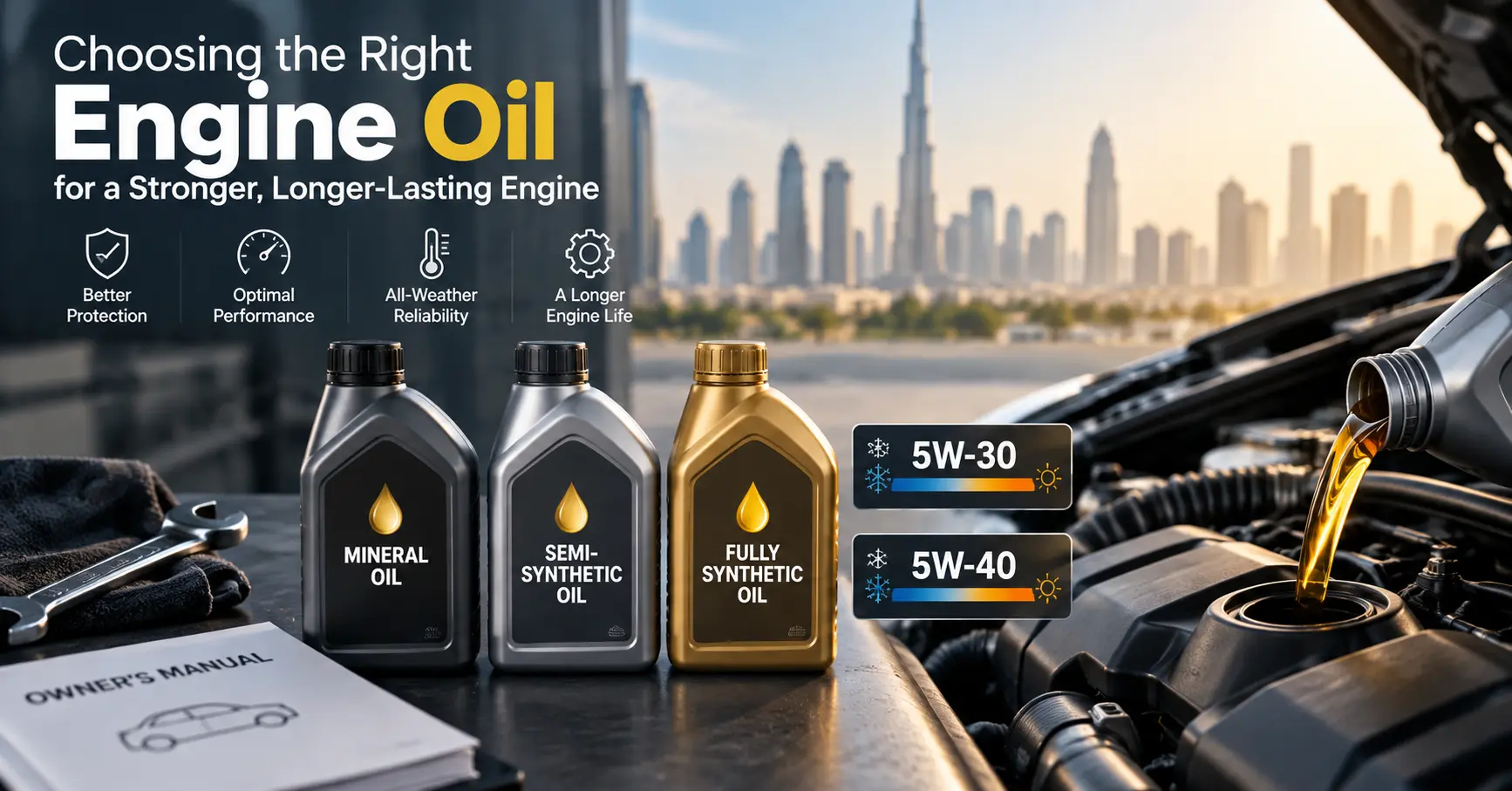
With the advancement of automotive technology, your engine oil needs can change over time. Your car needs are not what they were five years ago, and they may not be the same five years from now. As the engine ages and driving conditions change, the engine oil that once worked well might not be the right fit today.
There isn’t one single engine oil. Motor oils differ from each other in two distinct ways. Base oil composition: mineral, semi-synthetic or synthetic; and Viscosity Grade: how the oil flows at different temperatures, such as 5W-30 and 5W-40.
Both these elements combine to determine how well your engine is protected. While choosing a different type of motor oil, consult your vehicle owner’s manual.
What Are the Main Types of Engine Oil?
Engine oils and lubricants are generally categorised into three main types:
Mineral Oil – Derived directly from refined crude oil. The mineral oil lubricant provides basic lubrication and is suitable for older engines and cars with a basic design. It can’t withstand high temperatures as compared to other types of oils and needs frequent changes.
Semi-Synthetic Oil – it is a combination blend of mineral oils with added synthetics. Semi-synthetic oil is cheaper than synthetically developed oils yet offers improved performance, making it a popular choice in middle vehicles.
Fully Synthetic Oil – Chemically engineered oil to create uniform molecules and provide better performance across the temperature spectrum. Some modern engines require fully synthetic engine oils, but others do not.
Synthetic oil isn’t good for every vehicle; some seals in older engines were made specifically for mineral oil, and switching to the newer formula may cause leaks. Check your vehicle’s manual before making any switches.
Mineral vs Synthetic Oil: What Is the Difference?
Mineral oils and synthetic oils can be differentiated by their respective formulations, temperature performance, and stability.
Formulation – Synthetic oils are refined to form molecules of consistent size; they are free from any impurities which are present in mineral oil. Whereas mineral oils are of irregular sizes and do contain natural impurities.
Temperature Performance – Synthetic oils’ uniform molecular size ensures better flow in cold conditions; also, they are able to withstand high temperatures. On the other hand, due to nonuniform sizes of molecules, mineral oil becomes more viscous in cold, and it breaks down more rapidly in very high temperatures.
Stability – Synthetic oil has higher stability as compared to mineral oil. As it is produced through the chemical engineering process and consists of uniform molecules. Making it more resistant to oxidation and deterioration during higher temperatures and longer engine stressing.
Whereas mineral oil is derived from refined crude oil, and it contains impurities, as well as uneven molecule sizes, both of which decrease its stability. Which tends to break down easily when heated and oxidises rapidly, hence, losing its lube properties sooner.
Mineral vs Synthetic Oil: Quick Comparison
|
Factor |
Mineral Oil |
Fully Synthetic Oil |
| Source | Refined crude oil | Chemically engineered base stock |
| Cold-start flow | Slower, thickens more | Flows quickly even in cold |
| High-temp stability | Breaks down faster | Resists breakdown longer |
| Oxidation resistance | Lower | Higher |
| Typical change interval | Shorter | Longer |
| Cost | Lower | Higher |
| Best suited for | Older, simpler engines | Modern, high-performance engines |
What Are Engine Oil Grades: A Detailed Overview
The Society of Automotive Engineers System (SAE) created standardised codes for engine oil grades. Which are employed to measure engine oil viscosity, its thickness, and flowability across a range of temperatures.
The 5W-30 grade includes two separate numbers in its designation, addressing two performance temperatures:
The first number, W (which stands for winter), describes how the oil performs during cold conditions. While the second number shows what to expect when the engine warms up and reaches its regular operating temperature.
This two-number rating exists because the engine is subjected to vastly different conditions during start-up and normal driving. A single-grade oil can’t handle both extremes as well as a multi-grade oil can.
What Do We Mean by Engine Oil Viscosity?
Engine oil viscosity describes the ability of a fluid to flow at different temperatures. As thick engine oil will flow slowly, whereas thin oil flows fast.
When an engine is cold-started, it requires an oil having a higher flow rate to reach all moving parts before damage is done. This is why the “W” number matters (W stands for Winter). A lower number, such as the 5 in 5W-30, indicates the oil remains thinner in cold weather; it flows faster and reaches critical components faster.
As the engine warms up, there must be enough viscosity to create a thin film between the moving parts. This is what describe by the second number in the grade. Hence, engine oil is designed to change viscosity depending on the oil temperature, providing appropriate levels of oil thickness regardless of the temperature.
5W – how the oil behaves in cold-start performance.
Lower number = thinner, flows easier in cold weather.
30 – how the oil behaves hot (running temperature).
Higher number = thicker, better protection when the engine heats up
5W-30 vs 5W-40: What Is the Difference?
Both grades start with the same cold-start number, 5W, and behave the same when the engine is cold. But once the engine is warmed up, they differ.
The 5W-30 oil becomes substantially thinner when the engine reaches operating temperature, making it suitable for engines designed to operate with lower internal friction and fuel efficiency.
5W-40 oil is much thicker at operating temperature, so it is a much better fit for hotter, harder-working engines that require the high film strength between their parts. For businesses sourcing automotive oils in bulk, Black Bulls supplies a range of engine oils for different vehicle and operating requirements.
Such as some high-performance or diesel engines.
|
Aspect |
5W-30 |
5W-40 |
| Cold-Start Rating | 5W (same cold behaviour) | 5W (same cold behaviour) |
| Behaviour When Cold | Identical to 5W-40 | Identical to 5W-30 |
| Viscosity at Operating Temp | Becomes substantially thinner | Remains much thicker |
| Best Suited For | Engines designed for lower internal friction | Hotter, harder-working engines |
| Key Advantage | Better fuel efficiency | Higher film strength between parts |
| Ideal Engine Type | Standard passenger vehicle engines | High-performance or diesel engines |
Neither grade is universally better. The question depends on which one is right for your vehicle, as specified in your car’s owner’s manual. Using a heavier oil than recommended can lead to issues with fuel economy, engine wear and oil pressure, even if the oil itself is of good quality.
Choosing the Right Engine Oil: A Complete Buyer’s Guide
Here’s a step-by-step guide, presented below:
Owner’s manual guidance
The manual lists the detailed equivalent grade of viscosity and the specific requirement by your manufacturer.
Match the OEM specifications
Manufacturers will specify performance standards for the recommended oil in their engines. Look for terms like OEM-approved’ or manufacturer-specified.
Confirm the Viscosity Grade
Ensure that the oil matches the grade listed for your climate and engine type.
Check the API/ACEA Specifications
Industry certifications indicate that oil has met industry standards for minimum performance and quality levels. API certifications are more common for the North American market, especially for petrol engines, whereas ACEA validates European standards for petrol and diesel engines.
Consider your engine type.
Turbocharged, high-performance and diesel engines may require a different formulation to standard petrol engines.
Factor in your operating conditions
Short bursts, towing, extreme heats and colds and other factors can dictate the grade and formulation best suited to your requirements.
Engine Oil Selection for Vehicles in the UAE
The vehicles in the UAE run at very high ambient temperatures for most of the year. This condition makes it even more crucial to use engine oil capable of combating the effects of heat, especially thinning of the oil and oxidation. For businesses sourcing lubricants for automotive and industrial applications, reliable lubricant suppliers in the UAE can provide products suited to different operating requirements.
This is why most lubricant buyers across the UAE, including major hubs like Jebel Ali, home to manufacturers such as Black Bulls, prefer fully synthetic oils, which have a wider/higher viscosity at operating temperature.
The search for the best engine oil in Dubai garages is still the same, prioritising your vehicle manufacturer specifies. If the manual calls out a particular grade and rating, then that specification has already been approved across a broad spectrum of hot and cold temperatures. For businesses looking for reliable engine oil suppliers in Dubai, choosing a supplier that can provide the required viscosity grades and specifications is also important.
Common Mistakes When Choosing Engine Oil
Choosing engine oil seems simple until you’re standing in front of a shelf full of options. Individuals make mistakes by choosing motor oil depending on price or a single factor like viscosity.
Here are some common mistakes to avoid:
Relying on grade number only
Grade number doesn’t alone decide if the oil has the right chemical and performance requirements for your engine.
Ignoring the OEM specs
With testing by the automakers using a specific oil formulation and additive package to meet each engine, the OEM data should never be ignored or dismissed.
Assuming thicker oil is better.
Thick oil is not always better. The wrong viscosity could cause more friction, worse fuel economy and increased load on the oil pump.
Mixing incompatible products.
Different additive packages can sometimes be incompatible when mixed. Switching from one brand to another halfway through the oil cycle loses performance without checking the compatibility beforehand.
Using price as a primary criterion.
Cheap oil can not only not be formulated with the right additive package but can also be poorly stable. Therefore, it is best to get the specification right first and then compare within that group.
Conclusion
Engine oil comes in three different types: mineral oil, semi-synthetic, and fully synthetic oil. They all respond to heat and stress differently and have different recommended applications, engines and drive cycles. Viscosity grades, such as 5W-30 and 5W-40, tell you how oil flows at cold start-up and at operating temperature.
UAE heat could act as one of the deciding factors but never be substituted for the grade and performance standard demanded by the manufacturer. The correct engine oil is the one that meets the manufacturer’s specified viscosity grade and performance rating.
Frequently Asked Questions (FAQs)
Q1. What are the three main types of motor oil?
Engine or motor oils are categorised into 3 types: mineral oil, semi-synthetic, and synthetic oil.
Q2. What is the difference between synthetic and mineral engine oil?
Synthetic oil is an engineered oil that has a higher quality than mineral oil. Where mineral oil is derived from refined crude oil.
Synthetic oil has a higher heat resistant and is better for the protection of the engine. Whereas mineral oil has low heat resistance and contains natural impurities.
Q3. What is the meaning of 5W30?
5W30 is the grade of oil. The number ‘5’ represents the flow of oil at cold temperatures, while the ‘W’ indicates that the oil was tested at winter temperatures. The last number refers to the flow of oil when your engine is on.
Q4. What is the engine oil viscosity?
The viscosity of a fluid is an indication of its flowability. It can be dependent on its temperature; the higher the viscosity of the fluid, the more viscous it is at low temperature; the lower the viscosity of the fluid, the more viscous it is at high temperature.
Q5. How do I choose an engine oil for my car?
Always use the oil viscosity grade and type of oil as recommended by your car’s manual or manufacturer.
Q6. Is thick engine oil better?
Not always; it all depends on the kind of engine you own and the geographical conditions you reside in. Thick oil offers greater protection but can also negatively impact efficiency when the engine is cold.