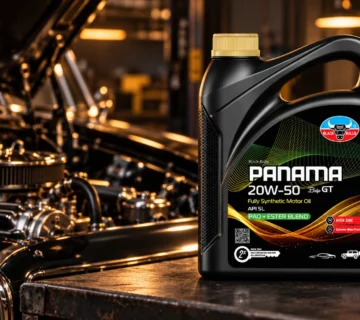

To verify whether an engine oil supplier in the UAE is genuine, look beyond the product catalogue. Check whether the company actually manufactures or officially distributes the lubricants it sells, has a verifiable UAE business and physical facility, provides technical product documentation, can explain product specifications clearly, and offers traceable supply. A genuine supplier should be able to tell you where the oil comes from, who makes it and provide documentation to support what is written on the label.
Finding engine oil suppliers in UAE is easy. Finding out who is actually behind the oil is where buyers need to pay attention.
A polished website, a warehouse full of cartons or a long list of viscosity grades does not automatically mean you are dealing directly with a manufacturer. Some companies manufacture and formulate lubricants. Others are authorised distributors. Some simply purchase products through different channels and resell them.
There is nothing inherently wrong with buying through a reseller. The problem starts when you think you are dealing with the source and you are not.
For a workshop, fleet operator, dealership or performance-car owner, that distinction matters. Engine oil is not a product where an attractive price should be the only deciding factor.
Start With One Simple Question: Who Makes the Oil?
Ask the supplier directly.
Do you manufacture the lubricant yourselves, are you an authorised distributor, or are you reselling another company’s product?
A serious supplier should give you a straightforward answer. If the response keeps moving between “we supply,” “we source” and “we work with manufacturers” without actually identifying the manufacturing source, ask more questions.
If a company claims to manufacture lubricants in the UAE, check its company details and manufacturing address. A manufacturer should have a real operational footprint, not simply a sales office.
For example, Black Bulls identifies itself as Black Bulls Grease & Lubricants Manufacturing LLC and publishes its manufacturing location at National Industries Park in Jebel Ali, Dubai.
That is the kind of information buyers should be able to verify.
Ask for the Technical Data, Not Just the Brochure
One useful way to compare engine oil suppliers in UAE is to see what technical information they are prepared to provide.
A marketing brochure can tell you an oil offers “maximum protection” or “high performance.” That sounds good, but it tells a mechanic or fleet manager very little.
Ask for the Technical Data Sheet (TDS). Depending on the product, it should provide useful information such as viscosity grade, viscosity at specified temperatures, viscosity index, flash point, pour point, performance levels and other relevant physical properties.
Then compare those details with the product label and the supplier’s website.
This is particularly important when buying oil for demanding applications. A turbocharged performance car driven hard in UAE summer conditions has different requirements from a lightly used passenger vehicle. A commercial diesel fleet has another set of operating demands again.
The specification must suit the engine. The supplier should be able to explain why it does.
Check Whether the Product Range Makes Technical Sense
A genuine lubricant business usually understands applications, not just pack sizes.
Look at how its range is organised. Are petrol and diesel engine oils clearly differentiated? Are SAE viscosity grades and performance specifications provided? Can the supplier help you select oil according to the vehicle manufacturer’s recommendation?
For example, Black Bulls SYNORA 0W-20 SN is designed for petrol-engine applications requiring a low-viscosity synthetic oil, while Black Bulls TIARA 10W-30 CI-4/SL is intended for diesel-engine applications requiring a different performance profile. Having clearly differentiated products for different engine types helps buyers select oil based on the vehicle manufacturer’s specification rather than choosing a grade simply because it is available.
The important point is not simply that several grades exist. It is that the supplier can provide technical information behind them and help buyers match the lubricant to the OEM requirement.
Look at Traceability Before You Place a Large Order
This becomes especially important for workshops, dealerships and fleets buying drums, cartons or larger quantities.
Ask what information is available for the supplied batch. Check packaging consistency, batch or production identification where applicable, seals, labels and invoices. If you regularly purchase the same lubricant, keep records from previous deliveries.
Unexpected differences deserve a question.
That does not mean every packaging variation indicates a counterfeit product – manufacturers can update labels and packaging. But a professional supplier should be able to explain legitimate changes rather than asking you to ignore them.
When evaluating engine oil suppliers in UAE, also ask how the product reaches you. Is stock coming directly from the manufacturer or an authorised channel? How is it stored? Can repeat orders be supplied consistently?
For commercial buyers, supply-chain reliability can be almost as important as the oil itself.
Be Careful With Prices That Do Not Add Up
Everyone wants a competitive price, particularly when purchasing lubricant in volume. But engine oil has real costs behind it: base oils, additive packages, blending, testing, packaging, storage and distribution.
If one quotation is dramatically below comparable products, find out why.
It may be a genuine commercial offer. It could also be old stock, parallel-market stock or product from an unclear source. Price alone cannot tell you which.
For a fleet running dozens of vehicles, saving a small amount per litre loses its appeal quickly if inconsistent lubricant quality contributes to increased wear, deposits or unplanned downtime.
A Good Supplier Should Be Comfortable With Technical Questions
This is perhaps the simplest test.
Ask about the recommended viscosity. Ask what specification the oil meets. Ask for the TDS. Explain the vehicle, engine and operating conditions and see whether the recommendation changes.
Good lubricant suppliers tend to ask questions back.
What does the OEM specify? Petrol or diesel? What is the application? What operating conditions does the vehicle face?
That conversation is far more reassuring than being told, “This oil works for everything.”
Buy the Oil, but Verify the Source
Choosing between engine oil suppliers in UAE should not come down to who sends the cheapest quotation first.
For an enthusiast protecting a performance engine, a mechanic responsible for customer vehicles, or a fleet manager trying to control maintenance costs, knowing where the lubricant comes from provides an extra layer of confidence.
Check the company. Check the manufacturing or distribution relationship. Read the technical documentation. Look for traceability and ask questions about the application.
A genuine supplier will usually make that verification easier, not harder. And when the oil is expected to protect an engine through high temperatures, heavy loads and demanding driving, that transparency is worth taking a few extra minutes to confirm.
Looking for a reliable lubricant manufacturing partner in the UAE? Contact Black Bulls Grease & Lubricants for high-performance engine oils, technical support and dependable supply for automotive and commercial applications.