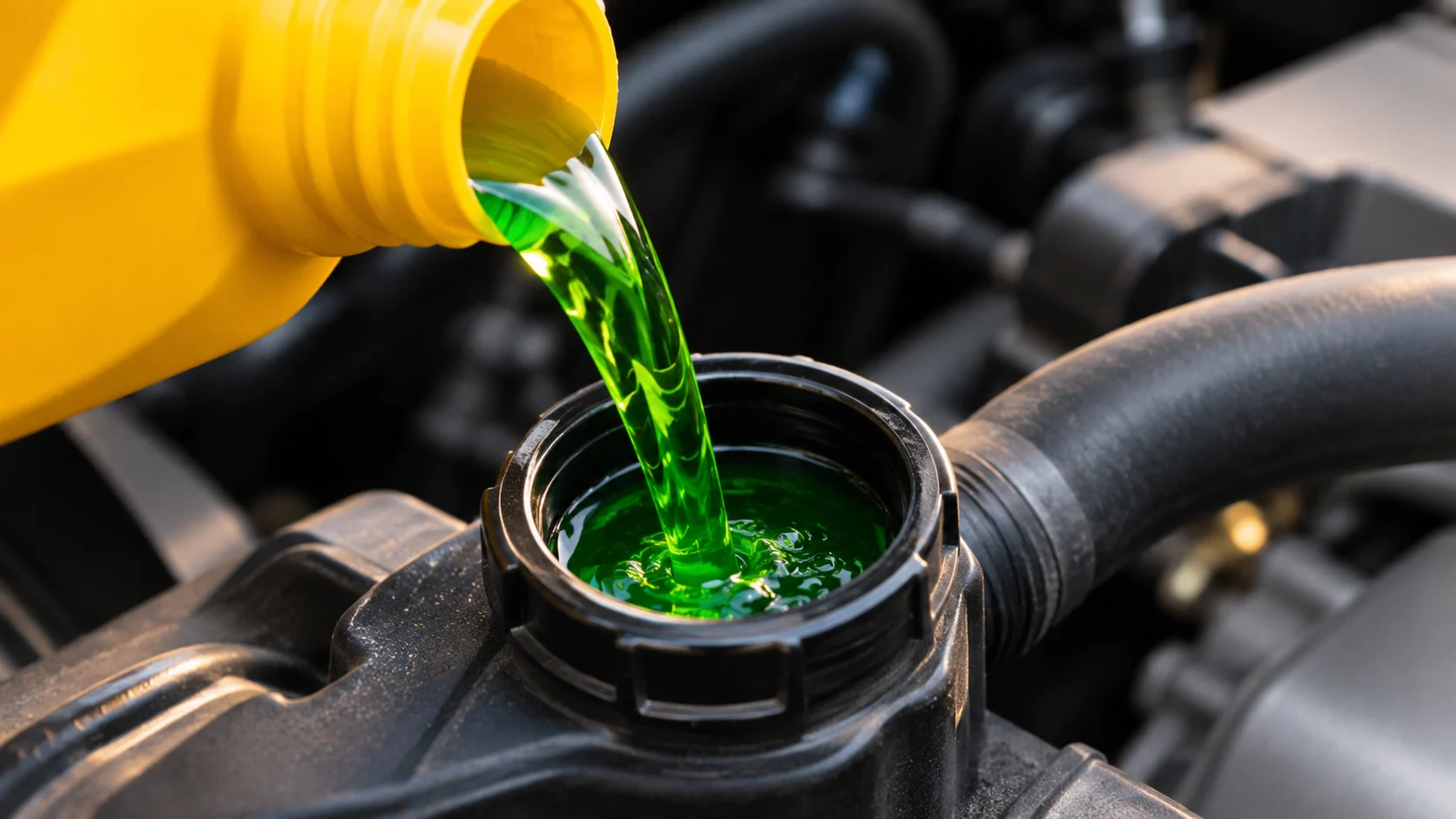
Engine coolant, also known as antifreeze or radiator coolant, is a liquid that helps to keep the engine from overheating, freezing, and corroding. The extreme temperatures in the UAE make this a vital requirement for your vehicle; it acts to increase the boiling point of the coolant, as well as prevent the formation of scale and rust inside the engine.
Choosing the right one can be cumbersome; hence, always follow guidance recommended by your manufacturer, not the colour.
What Coolant Does, and Why Antifreeze Matters in a Hot Climate
Engine coolant becomes important as it helps your engine transform fuel into motion, much of the energy of which also transforms into heat. The coolant flows through the engine, removes that heat, and goes to the radiator, where flowing air releases it.
With summer heat regularly exceeding 45°C, the cooling system works at or near its limit, particularly when the car is moving and the air conditioning is switched on.
Cooling relies on the coolant in four ways:
- Transfer of Heat – it causes heat to be transferred from the cylinder head and the block.
- Boil-over protection – Glycol coolants boil at a higher temperature than water, especially when heated in a pressurised system.
- Corrosion protection – Corrosion inhibitors protect aluminium, iron and brass components as well as water pump seals.
- Cavitation protection – inhibitors plug the minute vapour bubbles that can cause pitting on the surfaces of water pumps and cylinder liners.
Freezing conditions are rarely an issue here in the UAE, but the glycol used to prevent freezing is also what increases the boiling point.
Antifreeze vs Coolant vs Radiator Coolant: What’s the Difference?
These terms are used interchangeably, but the product format matters.
- Antifreeze – a glycol-based fluid with corrosion inhibitors, used in the concentrated state.
- Engine coolant – The liquid in the cooling system of an engine, which may be either a mixture of concentrate and water or a ready-to-use solution.
- Radiator coolant – an alternative term used for the same engine-cooling fluid.
- Coolant is available as either concentrated antifreeze, which must be diluted to the manufacturer’s instructions, or premixed, which is ready to pour. Check the label on the product before using.
For businesses looking to source cooling-system products, Black Bulls offers a range of coolants and antifreezes in the UAE for different automotive and commercial requirements.
Coolant types: IAT, OAT, HOAT and Hybrids
The type describes the corrosion-inhibitor chemistry, not the colour.
| Type | Full name | Typical use | Typical change interval* |
| IAT | Inorganic Additive Technology. | Older vehicle designs. | Shorter, often around 2 years. |
| OAT | Organic Acid Technology. | Many modern vehicles have long-life systems. | Longer, often 5 years or more. |
| HOAT | Hybrid Organic Acid Technology. | Many European, American, and some Asian vehicles. | Often around 5 years. |
| Hybrids (Si-OAT, P-HOAT, etc.) | Regional or brand variants. | Specific manufacturers. | As specified by the OEM. |
There is no one-size-fits-all rule that can guarantee IAT, OAT, or HOAT for every make, model, or year. As always, check the owner’s manual, required coolant standard, and any manufacturer approval.
Does coolant colour matter? Red, Green, Pink, and Blue Explained.
Not that much; colour is a dye. It just gives you a spot where the leak is, but it will give you no information about what is in the bottle.
- Green does not always mean IAT, and red is not always OAT.
- Pink, blue, and orange are utilised differently by various companies.
- Note that the two coolants of the same colour may have an incompatible chemistry.
- Rule: match the specification or standard in your manual; don’t use the colour.
Use as a loose guide: green usually indicates older IAT products; red, pink, and orange are always around OAT and HOAT. Use that as a hint and take guidance from your vehicle manufacturer and seek help from the manual to verify the answer.
Concentrate or ready-to-use? Mixing ratios and water quality.
The majority of vehicles use 50/50 concentrate and water; also, it is not universal, providing heat transfer, boil-over, and corrosion protection. Certain manufacturers require a different ratio; be sure to refer to your owner’s manual and the label on the product.
If using concentrates, always dilute them with demineralised or deionised water. Tap water has minerals that can cause scale deposits in your radiator and heater core. UAE tap water is very often hard water.
Concentrate – more value for workshops, fleets, and those who blend in bulk.
Ready to mix – easy for topping up as well as preventing possible mixing issues.
Can you use water instead of coolant?
Yes, you can run water instead of coolant if you have a low coolant level; using plain water rather than an empty system appears to be a temporary fix.
Water boils at a lower temperature when used by itself; it causes scale and rust and offers no corrosion protection. Drain and refill with the right mixture of coolant as soon as possible, as the water will also dilute any coolant remaining.
Can you mix coolants? Brands, colours and types
No, avoid mixing coolants; combining different chemistries, for example, IAT with OAT, often lowers protection against corrosion and at times creates sludge or gel that obstructs passages.
- Same type, same spec – fine for topping up most of the time.
- Same colour – not a guarantee of compatibility.
- Different colours – never really a problem, but never assumed.
- Unknown coolant in the system – have a workshop flush and refill with the product specified.
- How Often Should You Change Coolant?
The OEM schedule always comes first. As a general guide only:
It is about 2 years for IAT; OAT and HOAT are generally 5 years, with the long-life products being even longer.
In the UAE heat, ensure the level and condition of the oil are checked more frequently than the minimum schedule, and adopt shorter intervals with heavy-duty or stop/start applications.
Seek help from your manufacturer and follow the manual, as there is no universal time for every vehicle.
Signs of coolant problems: leaks, overheating, and low level
- High engine temperature: Potential reasons involve insufficient coolant, obstruction of airflow, a defective thermostat, or issues with the water pump.
- Coolant level low: Could mean there’s a leak or some other cooling-system issue.
- Puddles under the vehicle: May be caused by a blown hose, radiator, water pump, or fitting.
- Sweet-smelling vapour or a lingering coolant smell: May be due to a coolant leak.
- Discolouration or residue: Residual matter around hoses, radiator or connections can indicate a leak.
- Repeated loss of coolant: Needs diagnosis, not repeated topping up.
How to check and top up coolant safely
Never remove the radiator or expansion tank cap when the engine is hot; the system is under pressure, and scalding fluid will be sprayed out. Ethylene glycol can be toxic, so wash up after any contact with the coolant and keep it out of reach of children and animals.
Follow these guidelines:
- Park safely – Turn off the engine, park on a flat surface, and let it cool down.
- Find the Reservoir – Use the owner’s manual to find the location of the coolant expansion tank and the min/max marks.
- Check the level – Ensure it is in the correct range when cold.
- Check for leaks – Find moist spots, worn hoses, and the area around accessible connections.
- Use the appropriate coolant – Fill the system with the relevant compatible product, if required, according to the manufacturer’s guidelines.
- Secure the gap – Replace the reservoir cap and keep an eye on the level and temperature of the engine after you restart the vehicle.
If the engine overheats, the coolant level drops repeatedly, or a leak is substantial, stop driving when safe and contact a qualified workshop.
Choosing Coolant for Workshops, Fleets and Distributors
With experience across automotive, marine, agricultural and industrial applications, Black Bulls Grease & Lubricants provides lubrication and coolant solutions for different operating requirements.
Here’s what to look for:
- Standards and chemistry of the label and TDS mentioned.
- Concentrate and ready-to-use options.
- Pack sizes tailored for workshop, fleet, and retail operations.
- Use verified OEM approvals only.
Black Bulls supplies engine coolants to the UAE. Speak to the Black Bulls team to discuss suitable engine coolant options for your vehicles, workshop, or fleet.
Frequently Asked Questions (FAQs)
Q1. Can I pour water instead of coolant?
Yes, in case of an emergency only. Water boils faster, and it does not stop corrosion. You should top up with the correct mixture of coolant as soon as possible.
Q2. Can I mix red and green coolant?
Avoid mixing these two coloured coolants. A particular colour can’t ensure compatibility; mixing two different coolants may lessen protection or cause deposits. Flush out and refill with the type recommended.
Q3. Does coolant colour matter?
Not as a guide to chemistry. Always match the manufacturer’s specification, not the dye.
Q4. How often should coolant be changed?
Follow your manufacturer’s schedule. A general guide would be IAT about 2 years and OAT or HOAT 5 years or more.
Q5. Is radiator coolant the same as engine coolant?
Yes. They are different names for the same fluid.