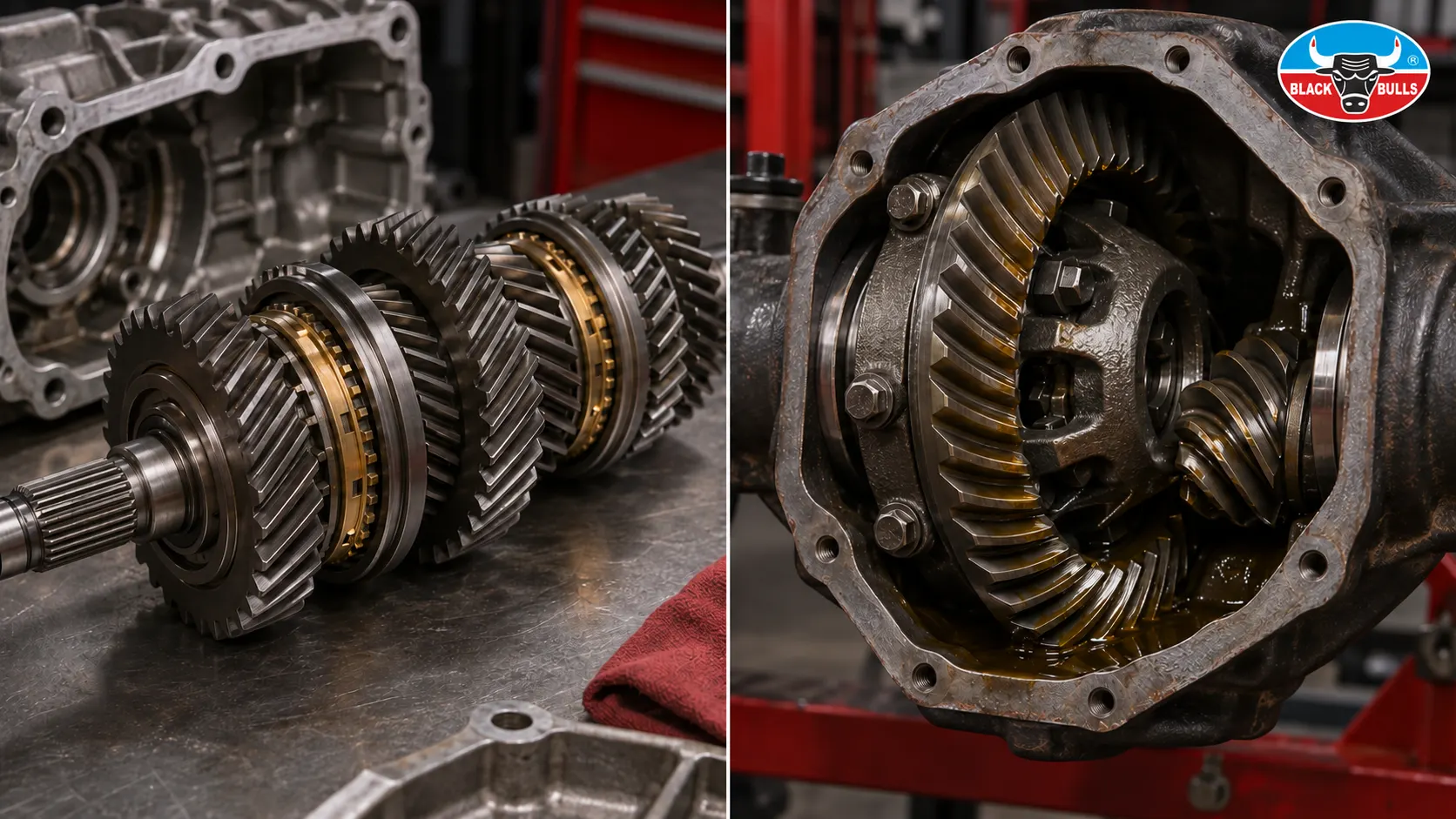
This Gear Oil Guide explains how gear oil reduces friction, protects vehicle components from wear, and ensures smooth operation. Gear oil is a specialised lubricant designed for manual gearboxes, axles, transfer cases, and differentials, protecting them against heat, friction, and wear.
It is formulated to withstand the stress of components working together under high pressure. Choose the right gear oil by ensuring the correct SAE viscosity grade and API performance category specified by the vehicle or machinery manufacturer.
Whether you’re driving a passenger car or a 4×4 adventure, the correct lubrication is a critical part of optimal drivetrain function. But how do you decide on the correct gear oil grades? What is the difference between GL-4 and GL-5? And when should you replace the oil? This Black Bulls guide has you covered with everything you need to know to pick the best oil.
What Is Gear Oil & Where Is It Used?
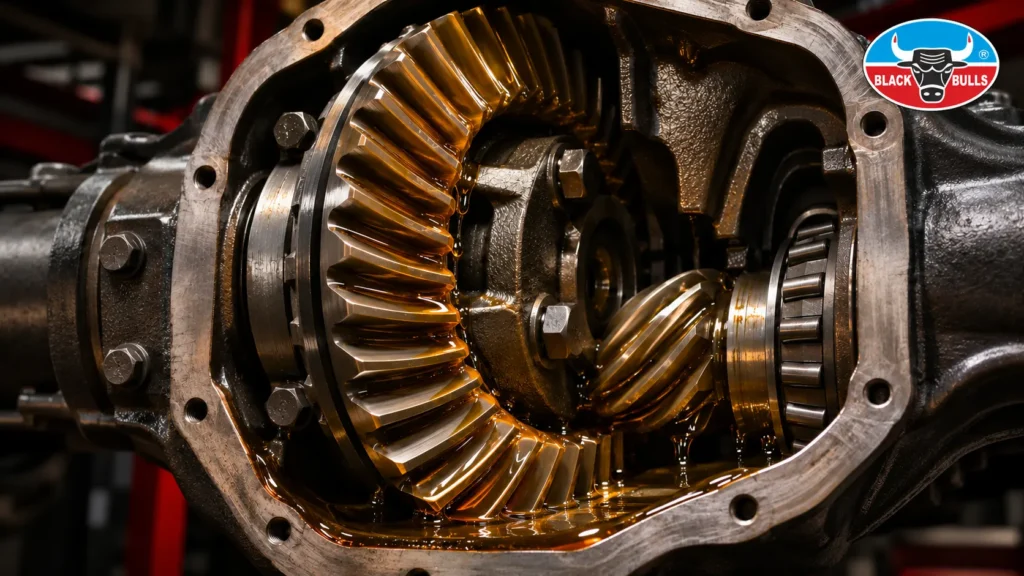
Gear oil is a specialised lubricant that is formulated to lubricate gears, bearings, and other drivetrain components. These components work under high pressure while transmitting power from the engine to the wheels.
The fundamental applications of gear oil include:
- Reduce friction between moving metal surfaces.
- Minimise wear and protect against corrosion.
- Help manage heat during operation.
- Support smooth gear movement.
- Protect components when carrying heavy loads.
The majority of common uses for gear oil include:
Manual transmissions – Lubricate gears, synchronisers, and bearings to support smooth shifting.
Differentials – Drive the gear system that lets the wheels turn at different speeds.
Transfer cases – Provide lubrication for the drivetrain parts of four-wheel drive and all-wheel drive vehicles.
Axle – Protects gears and bearings that transfer power to the wheels.
Different applications have different requirements. Using the existing product recommended by the manufacturer is a must.
Gear Oil vs Engine Oil vs Automatic Transmission Fluid
All gear oil lubricants work by reducing friction, but they are intended for various types of mechanical systems.
| Lubricant | Main application |
| Gear oil | Manual transmissions, differentials, and axles. |
| Engine oil | Internal engine components, including pistons, bearings, and moving parts. |
| Automatic transmission fluid (ATF) | Automatic transmissions require specific friction and hydraulic properties. |
Gear oil is made to handle the pressures and contact conditions in gear assemblies. Engine oil is designed for engine lubrication, and ATF is designed to support an automatic transmission’s hydraulic operation and clutch friction needs.
Substituting a different lubricant for the one specifically recommended by the manufacturer can result in inferior service, premature equipment wear, and even mechanical breakdown.
Understanding Gear Oil Grades: 75W-90, 80W-90, 85W-140 and 75W-140
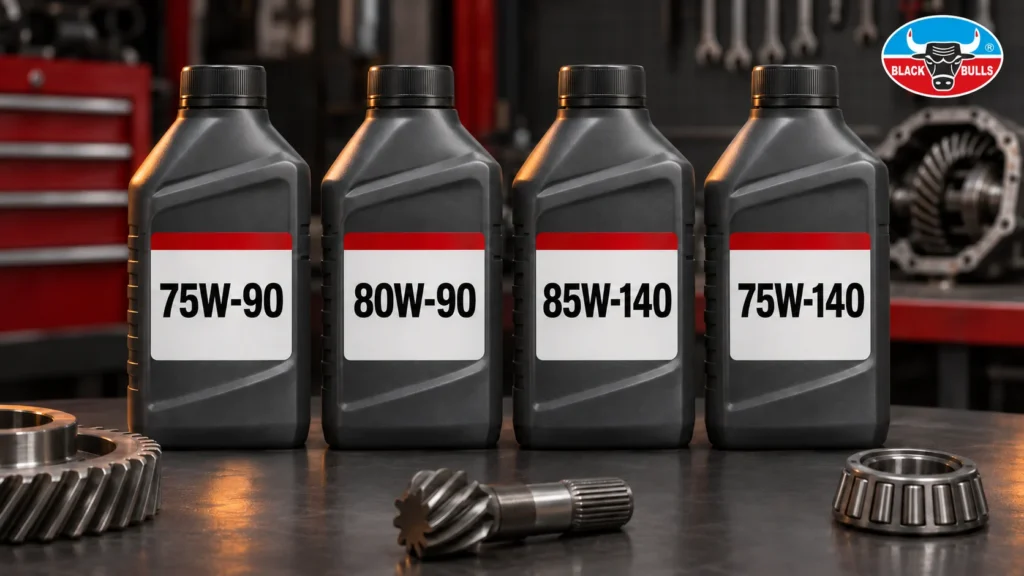
Gear oil grading indicates how thick a gear oil is at specific temperatures. The SAE J306 classification system applies to automotive gear oils and not to SAE J300 ratings of engine oils. A gear oil labelled “90” is not the same thickness as an engine oil labelled “90”, so never compare the numbers across the two systems.
For the engine-oil side of the comparison, read our engine oil viscosity guide. Keep the two grading systems separate when comparing specifications.
The grade has two components with a W in the middle. The first number, which is before the W, is known as the winter viscosity grade. The second number, after the W, is known as the high-temperature viscosity grade.
Grade | Typical character | Where you may see it |
| 75W-90 | Flows easily when cold, medium thickness when hot | Many manual gearboxes, axles and passenger-car or light-duty applications |
| 80W-90 | Slightly thicker when cold than 75W-90 | Axles, differentials and some older or conventional gearboxes |
| 85W-140 | Thick when hot, less suited to cold starts | Heavy-duty axles and differentials under high load |
| 75W-140 | Good cold flow with high hot thickness, often synthetic | Performance, heavy-duty and demanding axle and differential use |
API GL-4 vs GL-5: Why is this important?
API GL ratings describe the performance level and use of automotive gear lubricant. Knowing the difference between the two helps users avoid accidentally putting the wrong gear oil in a differential or transmission.
API GL-4
GL-4 oil is recommended in some manual transmissions and axles. However, GL-4 specification oil is appropriate for some synchronised gearboxes, depending on the formulation of the oil and the requirements of the manufacturer.
API GL-5
The main application for GL-5 oils is in heavily loaded gear systems, especially hypoid gears, which are present in many car differentials. They are designed to offer protection against extreme pressure in demanding operating environments.
Can You Use GL-5 Instead of GL-4?
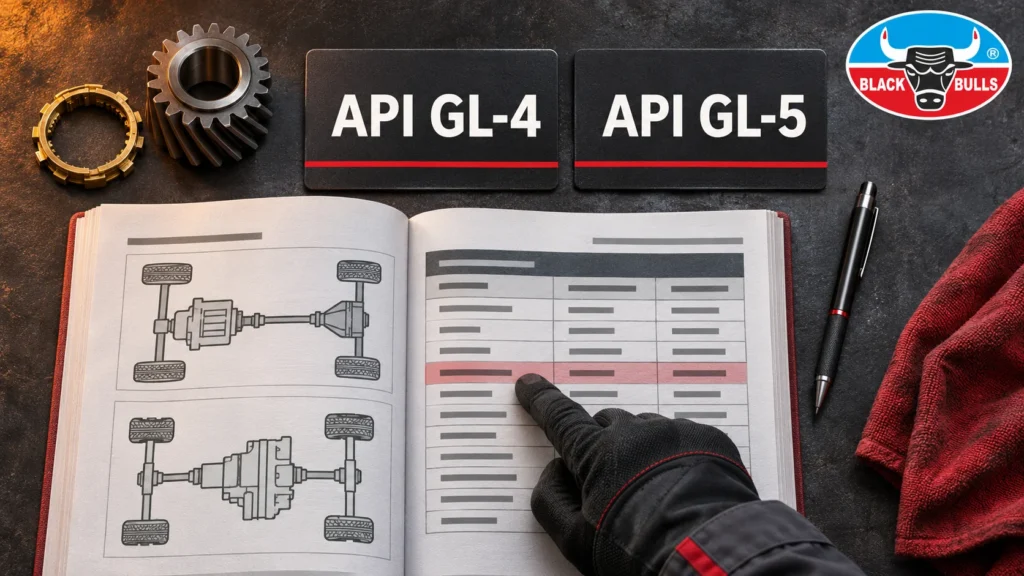
Not necessarily. Several manual gearboxes use copper alloys, brass, or other yellow metals for the synchronisers. In those cases, the lubricant formulation should have appropriate friction and material compatibility properties.
Certain GL-5 products are designed for specific manual transmission applications, but this suitability must be confirmed. Be aware that GL-5 is not always better for any gearbox. Be certain to use the API category as well as the lubricant classification specified in the handbook your manufacturer has supplied.
What Is Limited – Slip Differential (LSD) Gear Oil?
A limited-slip differential gear oil transfers power to both driven wheels when one wheel slips. Performance and off-road vehicles often have limited-slip differentials. Some LSD types work by setting a clutch plate between the wheel axles. These clutch plates require the right amount of lubrication and friction to function effectively.
LSD gear oil can include friction modifiers to decrease excessive chatter and noise. Different differential models may have specific requirements. Some will have a dedicated LSD oil, while others will need a certain additive. In all cases, check the lubricant requirement before you fill and again before you top up an LSD.
Differential Oil vs Gearbox Oil: What’s the Difference?
Although both are used to protect gears, their content and use may differ.
Differential oil is often used in final drive and hypoid gear applications that experience high contact pressures. Gearbox oil must be formulated to suit the needs of the transmission, which can include synchroniser compatibility, friction control, etc.
An oil that will work in a differential is not necessarily going to work in a manual gearbox.
Verify the suggested viscosity, API class, and approved producer standards for each component.
Auto vs Industrial Gear Oil
Automotive gear oils are designed for automobile transmissions, axles, and differentials. Industrial gear oils are formulated for equipment, including manufacturing equipment, conveyors, and industrial gearboxes.
The industry lubricants are generally chosen based on equipment-specific lubricant performance requirements and the ISO VG viscosity grade.
While both products are lubricants for gears, each may have its own formulation and use. Always choose the oil based on the instructions of the manufacturer of the equipment.
For machinery applications, our guide to choosing lubricants for industrial machines discusses operating conditions, viscosity and lubricant compatibility.
How Often Should Gear Oil Be Changed?
The schedule for the replacement of gear oil will be related to the vehicle, the transmission design, the lubricant specification, and the service, of course.
Some companies advise replacement anywhere from 40,000 to 100,000 km, while others specify longer miles or different intervals. This is just an example range.
When to Change Gear Oil in the UAE
The environmental conditions prevailing in the UAE may impose further demands on vehicles and plants, such as:
- High outdoor temperatures.
- Heavy traffic and frequent stopping.
- Driving over sand and rough terrain.
- Regular towing and carrying heavy loads.
- Long operating hours for commercial vehicles.
- Depending on the equipment’s classification according to the manufacturer, these conditions can be defined as severe service.
If you use your vehicle in extreme driving conditions, more frequent inspections will be needed at the recommended service interval. Don’t rely on the listed mileage estimate – check the manufacturer’s maintenance schedule to be safe.
Signs Your Gear Oil Is Low or Worn
Any signs of gear oil trouble can emerge over time. If you notice your car isn’t running quite the same, it could be a subtle indicator.
Some warning signs are:
Trouble shifting gears – Shifting may be hindered if the oil is low or inappropriate.
Whining or grinding noises – These noises might be the result of lubrication issues or mechanical damage.
Leaking oil – The presence of fluid on or near the gearbox or differential can be caused by a leaky gasket or seal.
Unusual odours – Overheated or degraded lubricant can produce noticeable odours.
Noise when loaded – Increased noise could be a result of gear or bearing wear or lubrication issues.
How to Check Gear Oil in a Car
The inspection requirements vary according to the type of vehicle. Some gearboxes have inspection plugs, but others need special tools and workshop procedures.
A trained professional helps in:
- Locating the correct inspection point.
- Checking the oil level following the manufacturer’s procedure.
- Inspecting the lubricant for contamination.
- Examining seals and housings for leaks.
- Recommend replacement or topping up when necessary.
- Don’t judge the condition of the lubricant by its colour.
What will happen if gear oil is not changed?
Oxidation, contamination, and additive depletion will occur, reducing the oil’s ability to protect moving components. If you keep on using the vehicle with insufficient oil, you may experience wear of components, which could result in more expensive repairs.
Choosing Gear Oil for Fleets, 4x4s and Heavy Equipment
Various vehicles and equipment require different lubricant specifications. Think about the following before you decide on a gear oil:
Commercial fleet – Be aware of the gearbox and axle requirements for each vehicle. Matching the correct standardised lubricant to the vehicle is a very effective way to manage stock control and maintenance.
4×4 vehicles – Ensure you verify the requirements of the gearbox, transfer case, front differential, and rear differential individually. For processes that involve LSD, make sure you consider this factor.
Heavy machinery – Adhere to the recommended viscosity and performance specifications provided by the manufacturer. Pay attention to operational hours, workload, and environment.
When sourcing lubricants for several vehicles or machines, use these questions to ask a lubricant supplier to check technical documentation, product suitability and supply arrangements.
Black Bulls supplies lubricants for automotive, commercial, and industrial applications, including SAE 75W-140 GL-5 PAO FSYN-BAJA ULTRA LSD gear oil.